South Barre Woman Killed When “Lusitania” Was Torpedoed, Three Days Before Her Wedding



𝐒𝐎𝐔𝐓𝐇 𝐁𝐀𝐑𝐑𝐄 𝐖𝐎𝐌𝐀𝐍 𝐊𝐈𝐋𝐋𝐄𝐃 𝐖𝐇𝐄𝐍 “𝐋𝐔𝐒𝐈𝐓𝐀𝐍𝐈𝐀” 𝐖𝐀𝐒 𝐓𝐎𝐑𝐏𝐄𝐃𝐎𝐄𝐃, 𝐓𝐇𝐑𝐄𝐄 𝐃𝐀𝐘𝐒 𝐁𝐄𝐅𝐎𝐑𝐄 𝐇𝐄𝐑 𝐖𝐄𝐃𝐃𝐈𝐍𝐆
𝐌𝐚𝐲 𝟕, 𝟏𝟗𝟏𝟓
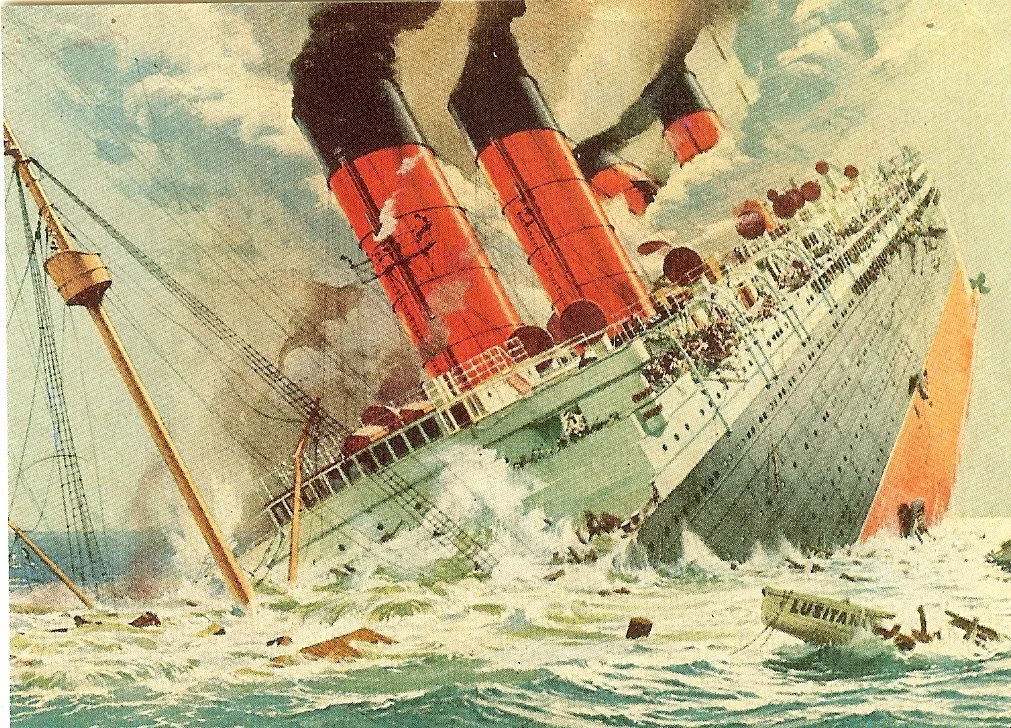
On this day (May 7) in 1915, 111 years ago, a German submarine torpedoed the British passenger ship RMS “Lusitania” off the south coast of Ireland. The “Lusitania” quickly sank with a death toll of 1,198 passengers and crew. The public outcry resulting from the sinking of this passenger ship was great, and the deaths of 128 Americans raised hopes on the part of the British that the neutral United States would join them in fighting the Germans. This, however, did not happen for almost two years. Although the “Lusitania” was a passenger ship, it did not follow the “Cruiser Rules” that would have spared it from unannounced submarine attack. The British government had ordered its ships to fly neutral flags and not to stop if challenged by a submarine, but instead to open fire, if armed, or to ram the submarine, if unarmed. As a response to the British orders, the Germans announced that the waters surrounding England were a war zone and that any ship found in that zone would be destroyed without first determining if the ship was neutral. In addition, the “Lusitania” was carrying munitions in its hold, making it a military target. Divers in 2008 documented the existence of more than 15,000 rounds of American ammunition that were being delivered to England.
Although the “Lusitania” caused a world-wide political reaction, in Barre, the news was gut-wrenching, personal, and tragic. On board was 19-year-old Ida Exley, a young worker at the Nornay Worsted Mill in South Barre. A native of England, she was on her way back to England to marry her fiancé, Harry Taylor. She was killed, probably instantly, when the torpedo struck the ship on May 7. That was three days short of her wedding day, scheduled for May 10. Ida’s cabin was in a direct line with the torpedo strike.
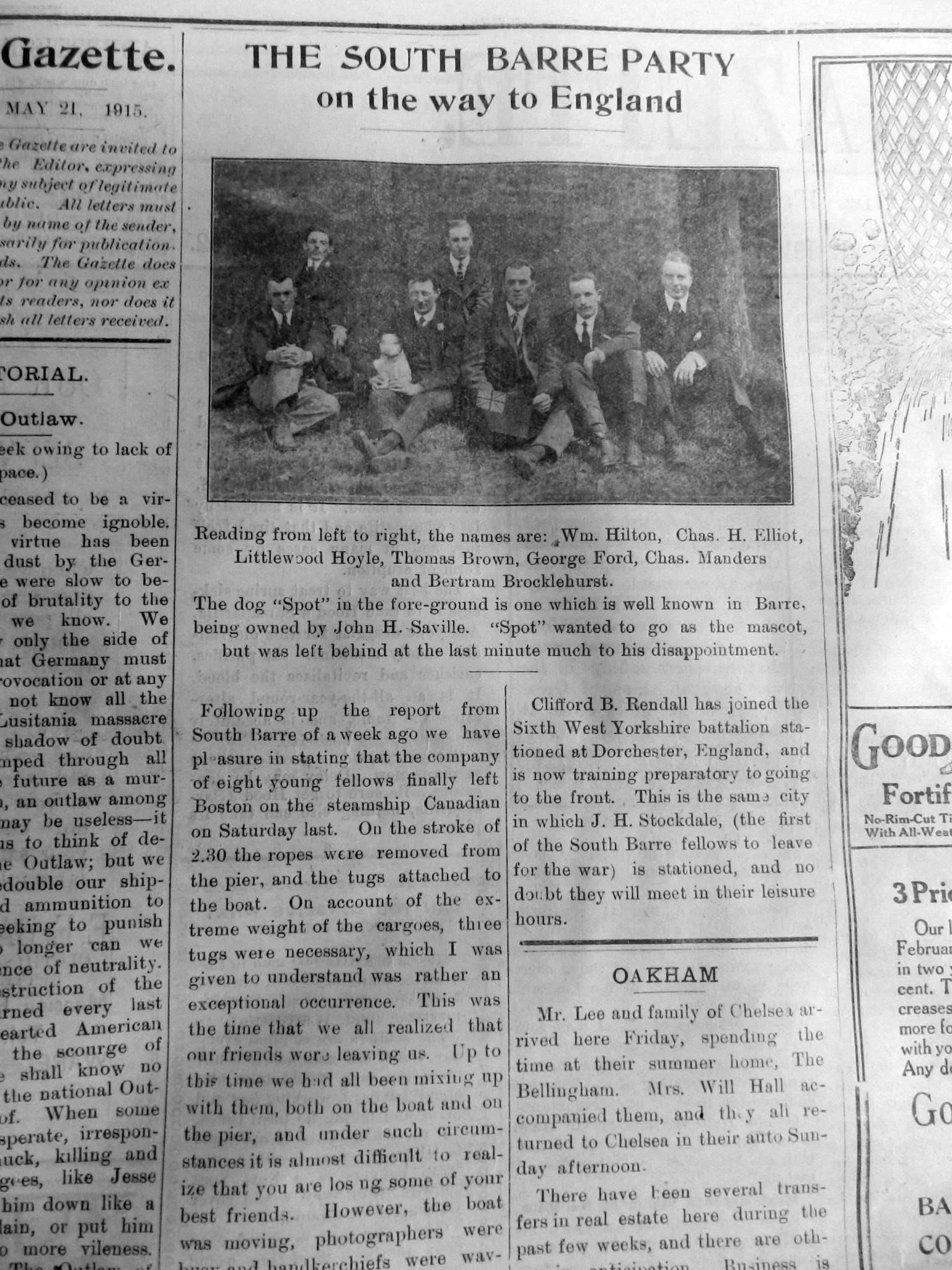
Ida’s body and the trousseau that she had so gleefully gathered for her married life were never found. Although it is not apparent in the only photo I have found of her, she was described as petite, 5’ 1” tall, blonde, with a fresh complexion and gray eyes. Her girlish appearance and her tragic fate tugged at the heartstrings of the young men of British origin who were working in South Barre. To avenge her death, seven of the young men immediately enlisted in various branches of the British or Canadian armed forces and went off to war. At that time, the United States was not a participant in the Great War (World War I), so joining the American armed forces was not an option.
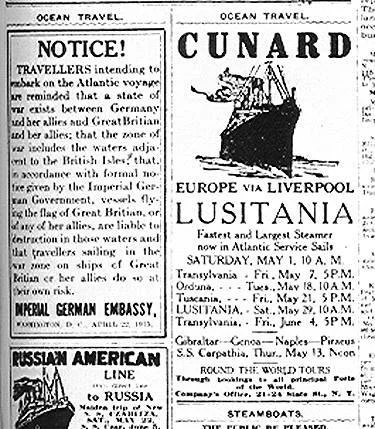
Prior to the “Lusitania’s” departure from New York on its final voyage, the German Embassy placed ads in American newspapers warning would-be passengers that the “Lusitania” might be torpedoed, as shown here. These ads were often placed next to ads for the sailing of ships like the “Lusitania.” Ida’s family and friends tried to convince her not to board the threatened ship, but her response was that if the ship started to sink at one end, she would just run to the other end.
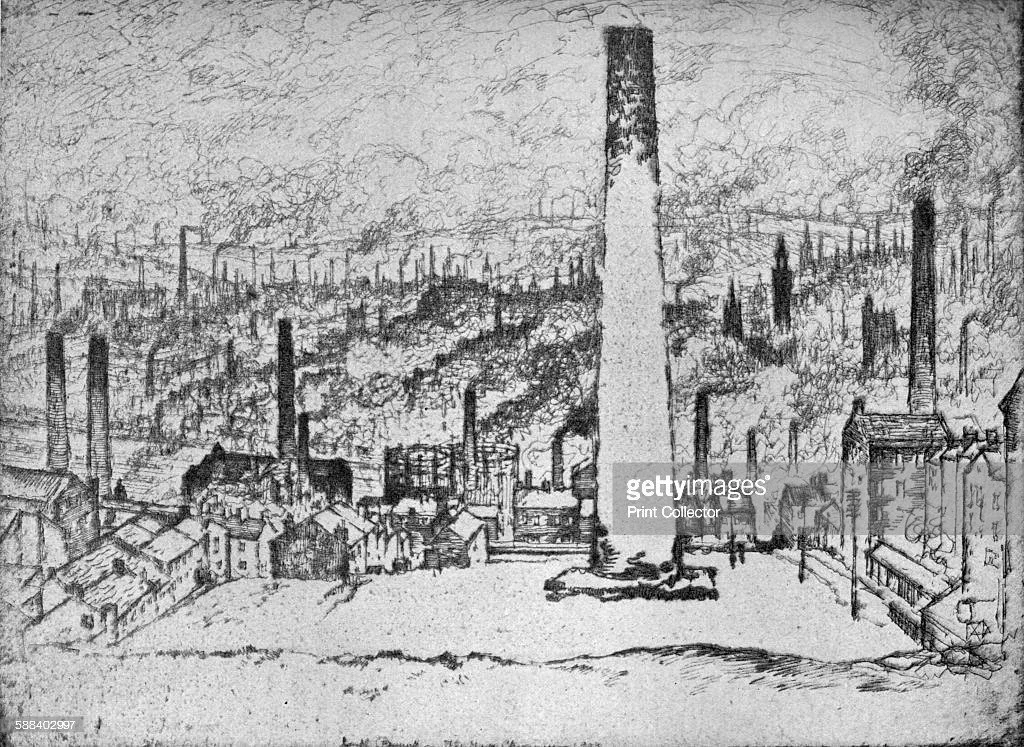
Ida was born in late 1895 in the village of Shipley, on the outskirts of Bradford, England, to Joseph and Hannah (Ambler) Exley. Bradford had been England’s “wool capital” for centuries. Hundreds of smokestacks pumped coal-generated pollution into the air; in winter, this pollution caused the snow to fall like a gray blanket. Workers’ housing was usually hundreds of years old, dark, and unhealthy.
In 1909, Joseph Exley decided to bring his family to America. South Barre provided a new opportunity for them. It took seven years for a wool sorter to learn his trade, and when the Bradford, England-based Francis Willey started his woolen mill in South Barre in 1903, he needed experienced workers. By 1910, the last United States Census taken before the “Lusitania” was torpedoed in 1915, about 940 persons of our town’s total population of 2,957 were foreign-born. Of the foreign-born, 472 came from countries under British control.
By 1910, the Exley family was living in Trafalgar Square in South Barre. The housing was just a few years old and was much cleaner and healthier than that of Bradford, England. Only one smokestack towered over the South Barre skyline, rather than the hundreds that polluted the air of their former home in England. The sunset could be enjoyed over the brick mill building without being obscured by coal smoke. They may have had a rabbit hutch or a chicken coop. An old postcard of Trafalgar Square with the Barre Wool behind it shows an almost idyllic picture of how life there might have been for the Exley family in South Barre.
Ida was listed in the 1910 United States census as being 14 years old and a “Spinster.” That meant that she was working at the Nornay Mill as a spinner. Young girls like Ida were valued for this work due to their nimble fingers and clear eyesight.
Soon a young man, Harry Taylor, came to work at the mill as the Master Painter. Harry was also a native of Bradford, England, where is parents owned a wallpaper and paint store. Shortly before the Lusitania tragedy, Harry’s parents asked that he return to Bradford and help in their store, which he did, but not before obtaining a promise from Ida that she would soon come to England and marry him.
Harry Taylor obtained a Special License to marry Ida Exley on May 10, 1915. He probably went to Liverpool, England, to meet the “Lusitania” and bring her to Bradford. His wait would have been in vain.
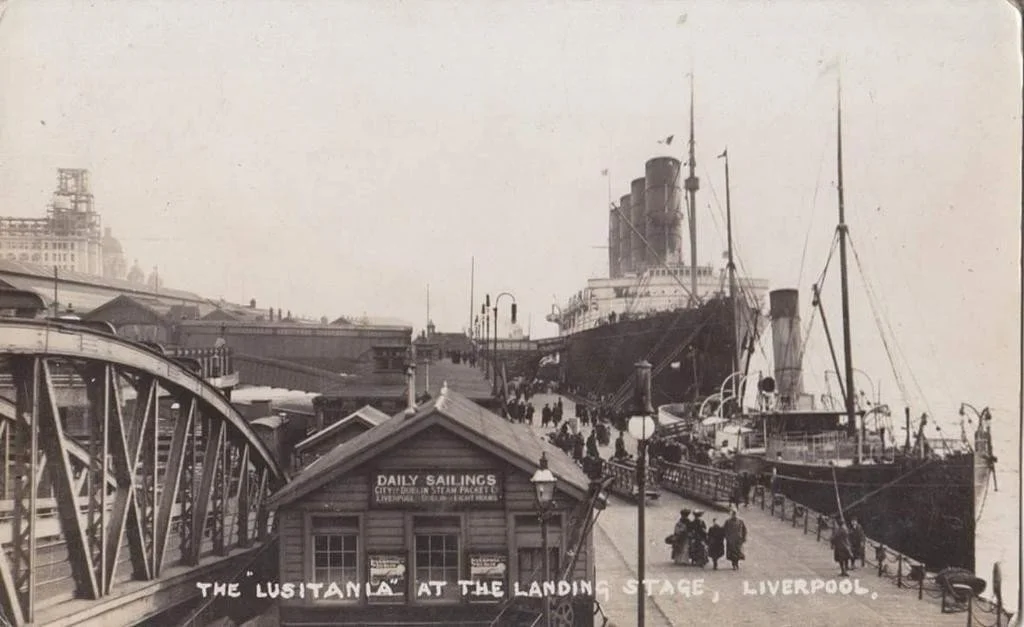
A photo shows where the “Lusitania” usually docked, and where I believe that Harry Taylor stood waiting for his future bride to debark on that fateful day. He had so much to tell her about the wedding plans, which would all come together in just three days’ time. At some point he was told the unbelievable, that the “Lusitania” had been sunk by a German submarine. Perhaps at first, he held out some hope for Ida’s rescue. On May 10, news by cable was received in Boston that Ida Exley was “lost.” She was to have been married that day. I have not been able to confirm what happened to Harry Taylor after the tragedy, partly due to the large number of men named Harry Taylor born the same year in Bradford.
The young English men living in South Barre had many reminders that it was their duty to avenge the death of the “Lusitania” victims. Knowing Ida personally, one within their own small community who was young and full of plans, no doubt spurred them on. They had worked with her father as a wool sorter; they probably socialized with her brothers.
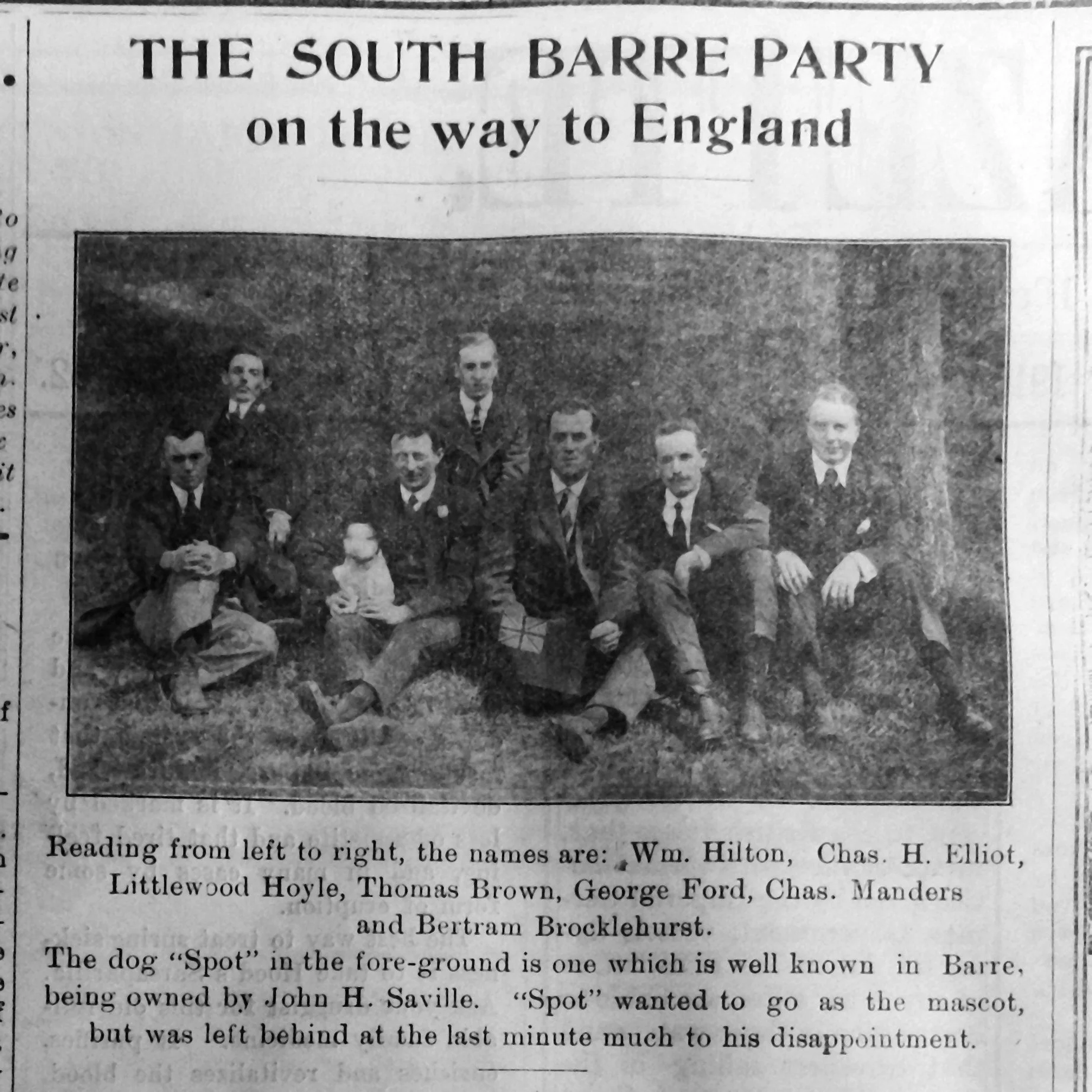
Within 30 minutes of receipt of the newspaper that carried the news of Ida’s death, which was probably May 10, five members of the wool sorting crew, all single, quit their jobs at the Barre Wool to go to fight in England. They were:
George Ford, also the Choir Master at Christ Church in South Barre.
Charles Harrison Elliott, also ass’t secretary of the South BarreCricket Club and Secretary of the Social and Athletic Association.
Charles Joseph Mander, just recently arrived from England.
Thomas H. Brown, whose brother-in-law, Kaye Whitaker and sister Ethel would become proprietors of the Blyth Hotel.
Bertram Brocklehurst
Also quitting their jobs to return to fight in England were:
Littlewood Hoyle of Netherthong near Bradford, assistant to the butcher in Barre Plains.
William Hilton, ass’t painter at the Barre Wool.
Herbert Heaton, teamster for the Barre Wool.
The little dog in the photo belonged to another Englishman, John Saville. The dog wanted to go to England as their mascot, but he stayed in South Barre. Many years later, John Saville lived near me on Kendall Street and did my parents’ income taxes. His wife sang in the Congregational Church Choir with me. As a child, I had no idea of the tragedy of Ida Exley’s death and its impact on the young men of South Barre.
Few traces can be found of Ida Exley’s life. She and her family joined the former Christ Episcopal Church in South Barre when they arrived, but there is no record of a memorial service at that church. She is not listed on the stone in the family plot at Glen Valley Cemetery. And because her body was not recovered, her name is not included in the memorial at Queenstown, Ireland.
Let us remember her today on the anniversary of her death.
Lucy Allen,
May 7, 2015
Rev. May 7, 2018
Rev. May 7, 2022
Rev. May 7, 2026